By: Chad Jones | Follow me on Twitter/X @ShutUpChadJones
Approaching the halfway point of this season, the Boston Bruins find themselves tied with the Ottawa Senators for the fifth-best power play success rate in the National Hockey League. Boston has been converting 25.5 percent of the time on the man advantage.
Special teams play has been one of the biggest areas the Bruins have improved in from last year. Boston only buried 15.2 percent of power play opportunities during the 2024-2025 season.
Five-on-four play was one of the glaring deficiencies Bruins Head Coach Marco Sturm and the rest of Boston’s coaching staff needed to focus on. And through the Bruins’ first 34 games, the power play unit has been noticeably harder to defend.
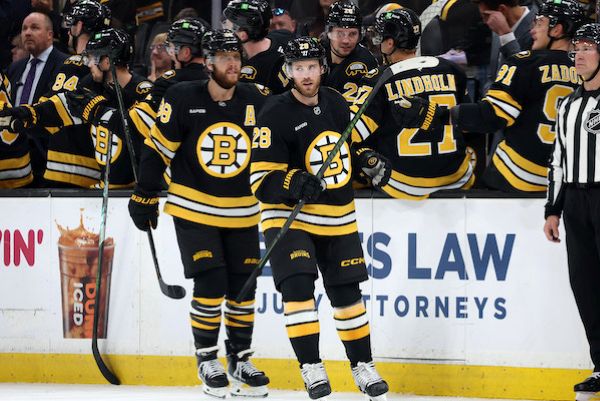
In Boston’s 4-1 victory over the Utah Mammoth Tuesday night at TD Garden, the Bruins buried one power play goal out of four opportunities. And their one score highlighted a key change to Boston’s play on the man advantage this season.
Elias Lindholm had the puck on his stick just outside of the crease. He could have attempted to jam the puck through Vitek Vanecek. But instead, he decided to flip the puck over to David Pastrnak, who had space to work with inside the right faceoff circle.
Pastrnak could have easily fired an attempt toward the net, but instead, he whipped a perfect dish over to Morgan Geekie, who was sliding over to the edge of the left faceoff circle. With Vanecek still overcommitted to a possible Pastrnak shot, Geekie promptly rifled the puck into the gaping cage.
Geekie potted his 23rd and 24th goals of the campaign during the contest. The Boston rifleman trails only Nathan MacKinnon, who already has 28 goals for the Colorado Avalanche.
This goal highlighted a few key changes to the Bruins’ power play attack. David Pastrnak is no longer just hunkered in Alex Ovechkin’s “Office” on the left side of the ice waiting to hammer one-timers into a shot blocker or ready goaltender.
The dynamic winger has been given the freedom to roam on the power play. He often finds himself on the opposite side of the ice, setting up his teammates.
This change has done wonders for Boston’s power play. It allows Pastrnak to settle into a play-making role, while still giving him the chance to blast shots on net when presented with opportunities. The adjustment has also made Boston much harder to defend on the man advantage.
Instead of predictably having Pastrnak stand in the left faceoff circle, where defenders and goaltenders can prepare for the obvious catch and shoot release, it is much more challenging to predict exactly where Boston’s best offensive player will be at any given time. This movement and unpredictability make life much more difficult for penalty killers and goaltenders.
Not to mention, Geekie has certainly shot down any doubt of his ability to score goals consistently at the NHL level. Having him posted up in that prime shooting position on the power play poses a serious problem for opponents.
A power play thrives on movement, creativity, and getting the puck into the hands of its playmakers. NHL defensive units are too stout to simply repeat the same plays and setups.
As deadly as Pastrnak’s shot can be, constantly having your play on the man advantage be teeing him up for one-timers can easily be thwarted. He buried nine power play goals last year and put up 23 points on the man advantage. This season, he has already lit the lamp six times on the power play and has picked up 15 points on the man advantage.
For Boston to continue to have success on the power play, they must not get stale. If they continue to emphasize creativity and movement and consistently position their skillful players in prime playmaking and scoring positions, Boston will continue to make opponents pay for taking penalties.



Leave a Reply