By: Neil Simmons | Follow me on Twitter / X: @NSimmz
Back in November, I wrote about how the Bruins second line of Casey Mittelstadt, Pavel Zacha, and Viktor Arvidsson had emerged as a “found money” group that was providing vital depth scoring for a lineup that came into the season without any concrete answers. Thanks in part to their contributions, the Bruins went into the Olympic break in sole possession of the second wild card spot in the East.
While they have remained the most consistent line Head Coach Marco Sturm has deployed all season, with a team-leading 355 minutes together, another line has emerged that could very well challenge their title as Boston’s best, anchored by one of their best young forwards.
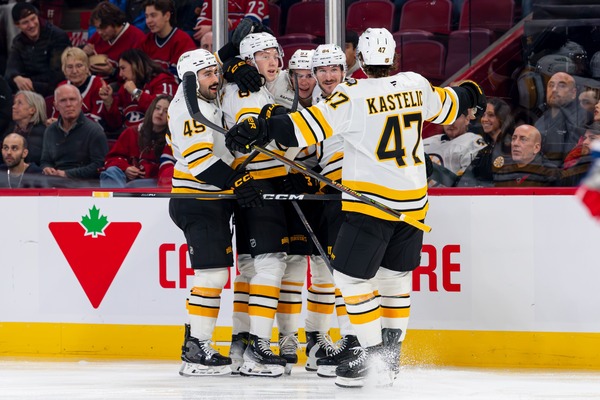
According to MoneyPuck.com, the title of the Bruins’ best line by Expected Goals Percentage (xG%) belongs to the third line: Tanner Jeannot, Fraser Minten, and Mark Kastelic, at 54.9%. What does that mean exactly? Essentially, when Jeannot, Minten, and Kastelic are on the ice together at even strength, they drive play and create more scoring chances than their opponents. In fact, they’re the only line combination with 150 or more minutes played that’s currently above water; Mittelstadt-Zacha-Arvidsson have dipped down to 49.3%.
While the aforementioned second line still holds the edge in accumulated Expected Goals (xG) with 14.6, the third line is second with 9.5. However, Jeannot-Minten-Kastelic are far more defensively sound, conceding nearly half as many xG Against – 7.8, compared to the second line’s 15.0. In other words, they’re capable of generating offense without sacrificing defense, adding another layer of production while still maintaining the Bruins’ “Piss and Vinegar” defensive identity.
The recent performance of the third line has been sparked by Minten’s emergence as a legitimate NHL center. The 21-year-old rookie has taken a massive step forward in his game over the past month and change, with 8-8-16 since the 6-2 road win in Edmonton on New Year’s Eve. At the time, Boston was floundering with seven losses in eight games and struggled to generate consistent offense. Once he flipped the switch, the Bruins ran off a 12-2-4 run into the Olympic break, and averaged 4 goals a game in January.
The contributions of his linemates shouldn’t be overlooked. Not only has Kastelic set a new career high in scoring with 17 points in a fully healthy 57 games (knock on wood), but he’s also been one of the best faceoff men in the league, winning 60.2% of his 425 draws. His win percentage is in elite company with the likes of Auston Matthews, Anze Kopitar, and Jonathan Toews. Much of the third line’s positive metrics begin with Kastelic winning possession at the dot.
Jeannot was a maligned acquisition over the summer for several reasons, including his lack of offensive punch, but he’s found a home on Minten’s wing and been a strong veteran presence for the young center. Of the four separate line combinations that Minten has skated at least 50 minutes with, his only two above 50% xG% have come with Jeannot on his flank, and in turn, Jeannot has produced his highest scoring season since 2021-22 with 20 points.
The third line is the best of both worlds for Sturm and General Manager Don Sweeney. They lengthen the lineup and provide an environment to develop one of the team’s budding young stars, while also imposing the physical identity that Sweeney has envisioned.
Having a deep forward group isn’t necessarily a prerequisite for a playoff contender, as plenty of more top-heavy teams have qualified for the Stanley Cup in the past. But for the Bruins, sitting in a playoff spot and playing meaningful games down the stretch with three lines capable of producing at even strength is significant for both the short and long-term outlook of the team.



Leave a Reply