By: Moxx Lorenze | Follow Me On Twitter / X @moxxmotion
If you listen closely enough, the roar of the 1970 Boston Bruins is still alive within the heart of Boston. The scrape of Bobby Orr’s skates cutting hard across the ice still echoes through the walls of TD Garden. Clad in black and gold, he lifted off the ice, arms stretched wide, body floating—That goal didn’t just win a Stanley Cup; it rewrote what it meant to play defense in the NHL.
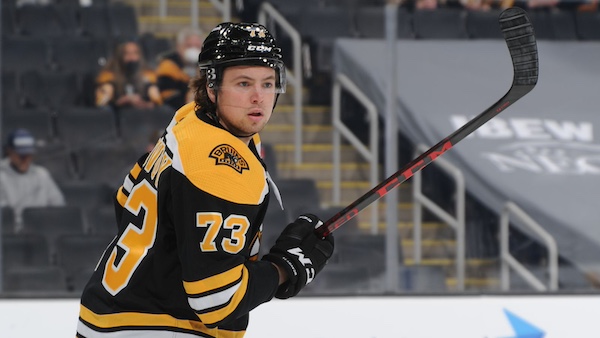
Decades later, a new yet familiar sound fills TD Garden. It’s distinctly sharper now—sticks snapping against composite boards and skates carving tighter turns. And at the heart of that modern symphony? Charlie McAvoy. Where Orr blazed through game after game, redefining what it meant to be a defenseman in the National Hockey League with every rush, McAvoy is more like granite shaped by relentless waves. Strong, unshakable, reshaping Boston’s blue line not in flashes, but with the steady force of a rising tide.
From Orr’s soaring brilliance to Bourque’s commanding precision, from Chara’s towering shadow to McAvoy’s unshakable presence, the Bruins’ defense has never been just a wall or a means to an end. It’s been a weapon. A tradition of brilliance carried through generations. And today, as McAvoy shoulders that legacy, if you listen close enough, you can still hear the pulse of history under his blades and throughout the walls. A black and gold thread tying past and present together.
Bobby Orr → Lightning on the Blue Line
In the late 1960s, hockey was an entirely different beast. Defensemen were gatekeepers, expected to guard the crease, chip pucks up the boards, and leave the highlight reels to the forwards. Their job was simple: hold the line and hope to slow the other team’s stars. Then came Bobby Orr.
Orr didn’t just skate—he struck like lightning, moving faster than defenders could process. He seemed to float above the ice, gliding as if gravity couldn’t quite catch him the way it did with everyone else upon the ice. With fearless strides, he carried the puck from end to end, igniting attacks that no blue liner had ever unleashed before. His 120-point season in 1969-70 didn’t just break records; it scorched them, burning away the very notion of what a defenseman could be in the NHL.
He changed more than just the ice inside the Boston Garden. Coaches across the league tore up old playbooks, designing new systems to free defensemen to join the rush and using Orr as the blueprint. Young players began dreaming not just of stopping goals but creating them themselves. The term “offensive defenseman” was born because of Orr.
As former teammate Eddie Johnston once said, “They say Bobby doesn’t play defense. Heck, he makes hockey a 40-minute game for us. He’s got the puck 20 minutes by himself. What better defense is there? If Orr has the puck, we’re going to score, not the other guys.”
Ray Bourque & Zdeno Chara → The Bridge
When Orr’s knees finally gave way, the Bruins’ blue line found its anchor in Ray Bourque. If Orr was the storm that reshaped the game, Bourque was the mountain it left behind. Unyielding, immovable, and rising taller with every shift. Over twenty-one seasons in black and gold, Bourque amassed 410 goals and more than 1,500 points—not by rewriting the book like Orr, but by mastering every line of it.
Then came Zdeno Chara. At six-foot-nine, Chara didn’t just cast a shadow—he turned the defensive zone into a skyline of his own across the ice. Opponents approaching the crease were met with an unbreakable wall of improbable reach, overwhelming strength, and unwavering willpower. And yet, beneath that towering frame beat the heart of a true captain, steering Boston through grueling battles and, in 2011, lifting the Bruins to their first Stanley Cup in nearly four decades.
Together, Bourque and Chara defined an era of defense less about flash and more about fortitude. Their dominance wasn’t measured in single, soaring moments like Orr’s, but throughout years and years of consistency, leadership, and a collective refusal to let Boston’s blue line crumble. Together, they bridged generations, ensuring that Bruins’ blue line brilliance never faded, only evolved.
Charlie McAvoy → The Living Foundation
Now, Boston’s blue line belongs to Charlie McAvoy. He’s something different—something shaped by every era before him yet forged for the modern game. Where Orr’s brilliance came in brightly blazing flashes, McAvoy’s power is quieter in its presentation, but in no way less commanding.
His power is present in a perfectly timed hip check that halts a breakaway, and a seamless transition from defense to offense that turns danger into opportunity. During the 2024–25 season, McAvoy averaged just under twenty-four minutes of ice time per night, showing the resilience required to shoulder relentless pressure shift after shift without ever breaking.
McAvoy’s game is built on a strength that bends, but never breaks. Shift after shift, he absorbs pressure, adjusts his angles, and pushes back with a calculated power. One moment he is stone, shutting down a rush with bone-crushing force; the next, he is water, flowing through the neutral zone with deceptive ease, turning defense into offense without a ripple of panic.
This is who the Bruins have now—a leader born from tradition but not bound to copy it. Stronger for being steady and more dangerous for being adaptable. With each stride of his skates, he’s building a new era of the Boston Bruins—one meant to endure.



This article rocks! Such illustrative language.
Nice article!
Love the passion , insight and great writing!