By: Moxx Lorenze | Follow me on Twitter / X @moxxmotion
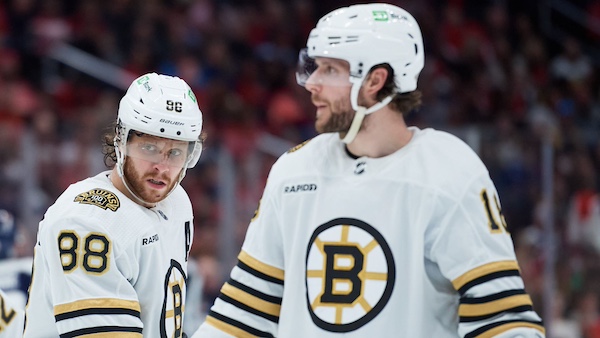
The crowd swells to its feet as David Pastrňák glides into the left circle, stick loaded, every eye in TD Garden tracking the inevitable. You know this scene. The shot cracks like a starter’s pistol. It’s glove side, under the bar, and TD Garden is already halfway through its celebration by the time the puck actually hits mesh. Up above on the jumbotron, the replays run in slow motion. Accompanying them is Pastrňák’s grin, his stick raise after the goal, and the fans at the glass. The spotlight, as always, finds number 88.
Rewind the tape a few seconds, because this play doesn’t start in the offensive zone. It starts just inside the Boston Bruins blue line, where Pavel Zacha angles his body between two forecheckers, then cushions a pass off the wall, and in one smooth motion, turns the puck up ice.
In three strides, he’s crossed the red line, and slid a no-look pass into the exact patch of ice Pastrňák likes best. The pass isn’t flashy. It’s measured, almost apologetically quiet, but it arrives with surgical precision. There’s no wind-up from there, no wasted motion. Just that signature crack from Pastrňák’s stick, and another tally for Boston’s biggest star.
Now, with Boston already stripped of so much of its forward core, there are some rumors about trading Zacha for a “better” player. On paper, the newcomer’s numbers might shine compared to Zacha’s. But chemistry isn’t measured in raw totals. It’s built in trust, timing, and the kind of quiet, repeatable plays that keep the team’s brightest star burning.
Take Zacha out of the Bruins picture, and the scene changes. The one-timer for Pastrňák might still come, but maybe the puck arrives a half-second late or a half-inch off the blade. In the NHL, that difference is everything. And before a season where the Bruins have already lost so much of their forward core, it’s a loss they can’t afford to test.
No Bruin has assisted on more of Pastrňák’s goals since Zacha arrived. Zacha has assisted on over twenty-six percent of all Pastrňák’s goals over the past three seasons. McAvoy is next at twenty-one percent. Marchand, before his departure, had sixteen percent. Flip it around, and Pastrňák has been part of nearly sixty percent of Zacha’s goals. And in a league where goals are decided in inches and milliseconds, that connection is a competitive edge.
But Boston isn’t the same team it was when Zacha first walked into the room in 2022. In just this past season, Brad Marchand, Brandon Carlo, Charlie Coyle, and Trent Frederic are all gone. Those exits didn’t just strip the Bruins of talent. They thinned out core leadership voices in the room, the kind of players who could pull the bench together in a bad stretch or settle it down after a rough period.
It’s easy to believe you can manage a roster like a spreadsheet. You can easily swap out any name on your team for another younger, cheaper, or with a flashier stat line. But you can’t trade for trust.
You can’t walk into a locker room and manufacture the comfort that lets a superstar play freely, knowing his linemate will be in exactly the right spot without a glance. You can’t fabricate a friendship forged over long flights, a shared language, and years of seeing the game the same way with the same person.
Take Zacha away, and the Boston Bruins will lose more than assists. They lose one of the last steadying hands in a recently reshaped locker room, and they risk dimming the very spotlight Pastrňák thrives in.
David Pastrňák will still score without Pavel Zacha. He will score—but not the same way. He will score—but he will not be the same player.
Boston’s front office will weigh cap space, age curves, and asset value. They should. But they also need to weigh the value of that one half-second. That’s how long it takes for a puck to settle perfectly on a blade instead of bouncing over it. That’s how long it takes for a pass to arrive in stride instead of into skates.
Pavel Zacha gives David Pastrňák those margins. None of it lights up a highlight reel on its own, but all of it lets Pastrňák stay at his best level. Unfortunately for Zacha, there’s no spreadsheet cell for how a player steadies a line or steadies a room. No column for the way a shared language shortens a learning curve, or the way quiet trust lets a scorer cheat a half-step into space because he knows the puck will get there.
The Bruins have already thinned their veteran forward core to the point where every remaining connection matters. Removing Zacha now wouldn’t just mean losing his assists; it would mean asking Pastrňák to re-learn his rhythm with someone new while carrying even more of the team’s offensive burden.
The Bruins are in a moment where every edge counts. And while Zacha’s game doesn’t always announce itself, it’s etched into the ice of Boston’s most dangerous scoring plays. Trade him, and you don’t just alter the roster—you alter the way your star scores and the way your locker room holds together.



Leave a Reply