By: Camryn Meece | Follow me on Twitter / X @MeeceCamryn
Today, a player who swings a stick at an opponent can face lengthy suspensions and widespread criticism across the National Hockey League. While hockey remains one of the most physical professional sports, the league now draws a clear line between rough play and the use of a stick as a weapon.
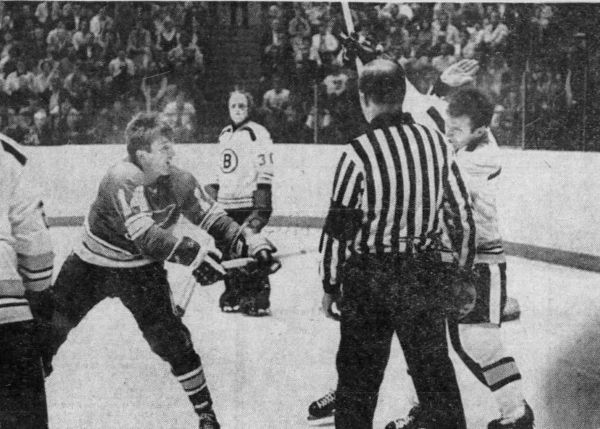
On September 21, 1969, during a preseason game between the Boston Bruins and the St. Louis Blues in Ottawa, Bruins defenseman Ted Green suffered a fractured skull after a violent altercation with Blues forward Wayne Maki.
Green had already established himself as one of the Bruins’ most dependable defensemen. A rugged competitor known for his physical style, he was coming off one of the strongest seasons of his career.
During the 1968-69 season, Green recorded 40 points in 76 games and earned a spot on the NHL’s Second All-Star Team, recognizing him as one of the league’s standout defensemen. His performance helped anchor a Bruins team entering one of the most successful periods in franchise history.
Just a little over halfway through the first period, Green and Maki became entangled in a confrontation that quickly spiraled out of control. After body checks and trading punches, both players raised their sticks. In the chaos that followed, Maki struck Green in the head, fracturing his skull and leaving the Bruins defenseman unconscious on the ice. Green was rushed to Ottawa General Hospital, where he underwent hours-long emergency surgery to remove bone fragments from his brain.
The severity of Green’s injury pushed the story beyond the hockey world, with newspapers and media outlets across North America following his condition. The Green-Maki altercation became a pivotal moment in how many viewed the role of the stick in hockey. The incident showed that the same stick used to pass, shoot, and defend could become dangerous when split-second decisions were made on ice.
The incident became even more unusual when it led to legal action outside the rink. Green and Maki became the first NHL players to face criminal charges as a result of an on-ice incident. Although both men were eventually acquitted, the case brought unprecedented attention to hockey violence.
Rather than leading to an immediate change in the NHL rulebook, the incident became one of the moments that forced hockey to reconsider where the line existed between competition and misconduct.
The injury could have easily marked the end of Ted Green’s career. Instead, it became the beginning of one of the most remarkable comebacks in Bruins history. After months of rehabilitation, Green worked his way back to the NHL. Although he was unable to play during Boston’s 1970 Stanley Cup run, he joined his teammates on the ice as they celebrated the franchise’s first championship in 29 years. Two years later in 1972, he helped the Bruins win their fifth Stanley Cup, completing a career that once seemed impossible.
More than five decades later, the Green-Maki altercation remains one of the defining incidents in hockey’s history of stick violence. Although the game has never lost the physicality that makes it unique, moments like the one in Ottawa helped shape how the NHL views dangerous use of the stick today.
Green went on to win two Stanley Cups with Boston and finish a career that once seemed uncertain. The events of September 21, 1969, remained a significant chapter in Bruins history.


Leave a Reply