By: Camryn Meece | Follow me on Twitter / X @MeeceCamryn
Every year, the National Hockey League’s (NHL) best players compete for one of the most recognizable individual awards in hockey: the Art Ross Trophy. The trophy goes to the player who finishes the regular season with the most points, and its list of winners includes some of the greatest scorers in NHL history. Wayne Gretzky, Gordie Howe, Mario Lemieux, and Connor McDavid are just a few of the legends who have claimed the award. But why is it called the Art Ross Trophy?
While the trophy is associated with some of the NHL’s greatest scorers, its history is closely tied to Boston—the man it is named after played an important role in the Boston Bruins’ early history. Art Ross was already a well-known figure in hockey when Charles Adams brought the NHL to Boston in 1924. A former player who had won two Stanley Cups, one with the Kenora Thistles and another with the Montreal Wanderers, Ross had also worked as a coach and official before Adams hired him to run Boston’s new franchise.
Ross became the Bruins’ first general manager and head coach, roles he would hold on and off for the next 30 years. He served as the team’s general manager until 1954 and had three separate stints behind the Bruins’ bench between 1924 and 1945.
Ross quickly made his mark on the young franchise. During his time in Boston, he helped turn the Bruins into a Stanley Cup contender and played a role in all three championships. He coached Boston to its first Stanley Cup in 1929 and returned to the bench to lead the team to another championship in 1939. Two years later, the Bruins won their third Cup under the guidance of Cooney Weiland.
Ross’s influence went beyond the Stanley Cups he helped bring to Boston. He also helped shape the game itself by introducing changes to hockey equipment and rules. His contributions included a redesigned goal net and an improved puck design.
Ross’s work with the Bruins had ended, but his involvement with the NHL continued. In 1947, Ross and his sons, Art Jr. and John, donated a trophy to the NHL for the league’s leading scorer. At the time, no award specifically recognized the player who finished the regular season with the most points.
The NHL named the award the Art Ross Trophy, giving Ross’s name a permanent place among the league’s individual awards. By then, he had already spent decades as a player, coach, and executive, including much of that time helping build the Bruins.
The first player to win the new trophy was Montreal Canadiens center, Elmer Lach. During the 1947-48 season, Lach led the NHL with 61 points in 60 games. He received the Art Ross Trophy after the season, becoming the first name on a list every NHL scoring leader since has aimed to join.
“I said then I hoped I’d live long enough to see one of the Bruins players win it.”
— Art Ross, on the presentation of the first Art Ross Trophy
Lach’s win began a tradition that has continued for nearly 80 years. The trophy has since been awarded to many of hockey’s biggest names, including Gordie Howe, Jaromír Jágr, Wayne Gretzky, Mario Lemieux and Sidney Crosby. For Boston fans, however, some of the most memorable names to appear on the trophy came later, when the Bruins began producing scoring champions of their own.
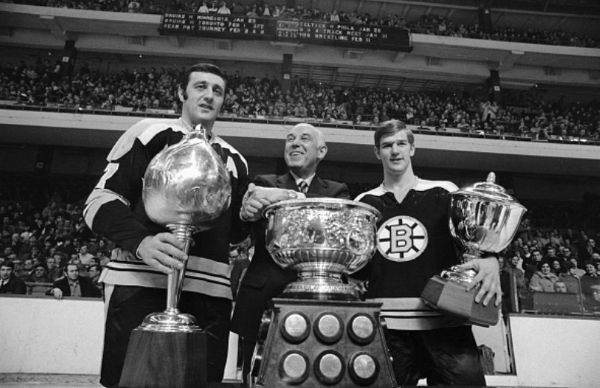
It would take 21 years for a Bruin to claim the trophy. Phil Esposito became the first Boston player to do so in 1969. Esposito won the Art Ross Trophy in five of the next six seasons, including four consecutive seasons from 1970-71 through 1973-74. His dominance during the Bruins’ offensive powerhouse years established him as one of the league’s premier scorers.
Esposito wasn’t the only Bruin to engrave his name on the trophy. The only interruption to his run came in 1970, when his teammate Bobby Orr claimed the scoring title. Orr would go on to win it again in 1975, becoming the first and only defenseman to lead the NHL in scoring.
Together, Esposito and Orr accounted for seven Art Ross Trophies for Boston, with a Bruin leading the league in scoring every season from 1969 through 1975. Those seven consecutive scoring titles helped make the Big Bad Bruins such a dominant team during that era.
Today, the Art Ross Trophy is one of the NHL’s most familiar individual awards, but its history goes back to a man who spent much of his career in Boston. Ross helped build the Bruins from their early days in the NHL, contributed to the game’s development, and eventually donated the trophy that bears his name. For Boston, the Art Ross Trophy is one more part of Ross’s long history with the Bruins and the NHL.



Leave a Reply