By: Andrew Patten | Follow me on Twitter/X @a_patten11
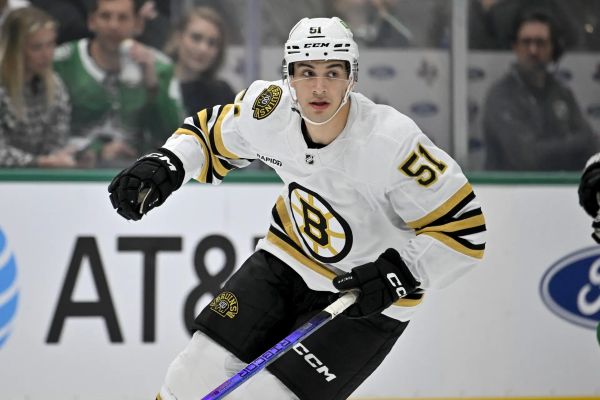
Matt Poitras enters the 2026-27 National Hockey League season at an important point in his development. The 22-year-old forward remains with the Boston Bruins after signing a one-year, two-way contract extension with an $850,000 NHL salary-cap hit. The contract gives him another opportunity to establish himself as a regular NHL player, but earning consistent ice time will require him to make the most of his chances.
Poitras already has NHL experience. He has played 69 games for Boston, recording seven goals and 20 assists. His 2025-26 season, however, was largely spent with the Providence Bruins, where he produced 44 points—13 goals and 31 assists—in 69 American Hockey League games. He also finished the season with a strong seven-game point streak from March 14 through March 28.
The biggest opportunity for Poitras could come at center. Bruins head coach Marco Sturm has said he prefers Poitras in the middle rather than on the wing, and he echoed that same mindset during his media availability on Wednesday. That is significant because Boston’s roster is particularly deep on the wings. Sturm indicated that Poitras would get looks at center at the beginning of training camp, but how exactly he fits into the equation remains to be seen. There is a path for ice time; however, it’ll be nothing short of an uphill battle.
The first step to ice time is straightforward: Poitras needs to demonstrate that he can handle NHL responsibilities at center. Playing center involves more than producing points. Poitras needs to show he can win enough faceoffs, support the defense, make reliable decisions with the puck, and contribute without possession. His career NHL faceoff percentage is 44.1%, so improving in that area could help strengthen his case for minutes.
Boston’s 2026 training-camp roster includes established centers like Elias Lindholm, Pavel Zacha, and Sean Kuraly, as well as younger players such as Fraser Minten, James Hagens, and Marat Khusnutdinov, who have the ability to play down the middle. The Bruins also have Mark Kastelic, who would take faceoffs on his strong side. Michael Eyssimont has also played some center in his NHL career. That creates genuine competition for ice time. Poitras also has limited time to make an impression. The Bruins’ 2026 training camp is shorter under the new collective bargaining agreement, with Boston scheduled to play four preseason games before opening the regular season against the New York Rangers on September 29.
That makes every preseason appearance particularly important. Poitras does not necessarily need to lead the team in scoring. Instead, he can strengthen his case by consistently making smart plays, creating offensive opportunities, and showing dependable defense. A strong camp could also give Sturm confidence in putting him into situations beyond sheltered minutes.
One of the clearest ways for a young forward to earn a coach’s trust is reliability. If Poitras can consistently be in the right position, compete along the boards, track back defensively, and make safe decisions under pressure, he gives Boston another reason to keep him in the lineup.
His offensive ability is already part of his résumé. His 44-point AHL season demonstrated that he can generate offense at that level. The next challenge is proving that those skills translate consistently against NHL competition.
Special-teams usage could provide another path to more ice time. Poitras scored six power-play goals for Providence last season, tying for the team lead. If he can show that his vision and passing can improve Boston’s second power-play unit, even limited special-teams responsibilities would increase his overall minutes. More importantly, it could give him a defined role rather than making him simply another option among the team’s depth forwards.
Poitras’ route to more ice time in 2026-27 will likely involve several things working together: winning a roster battle, becoming more dependable defensively, improving his faceoffs, producing offense, and showing he can contribute on special teams.
The Bruins clearly still see potential in him. Boston chose to retain him on a new contract, and Sturm specifically identified center as the position where he can be most effective. Now Poitras has the opportunity. If he can turn his AHL production into a well-rounded NHL game during training camp and the regular season, he can give Boston’s coaching staff a compelling reason to keep him in the lineup—and potentially increase his role as the 2026-27 season progresses.


Leave a Reply