By: Tom Calautti | @TCalauttis
The Boston Bruins spent most of the 2024-25 offseason attempting to reestablish the organization’s identity. They hired a new culture-building head coach, got their goaltending tandem in order, and even added more ‘piss and vinegar’ to their lineup.
While culture, grit, and goaltending are three critical pillars of any team, they aren’t the only things management did to restore their organizational identity. One key aspect of Boston’s early success has been the rejuvenation of its fourth line.
It may not be the flashiest part of any hockey team, but unquestionably, one of the keys to a successful squad is a bottom trio that can impact the game on and off the scoresheet. Bruins fans of the last 20 years know this better than most, being blessed with the 2010-11 Merlot line and the 2019 Kuraly, Acciari, Nordstrom group. Simply put, the Bruins are at their best version of themselves when they have a functional, scale-tipping fourth line.
That hasn’t really been the case over the past two seasons. Following the record-setting 2022-23 campaign, Boston struggled to find consistency with the bottom of their forward group.
The 2023-24 team spent most of the season with Johnny Beecher centering Jakub Lauko and Oskar Steen. That trio spent 75 minutes together, outshot 16-34, and out-chanced 15-32. Then, head coach Jimmy Montgomery didn’t have a finalized fourth unit until the playoffs came around, when he united Beecher with Pat Maroon and Jesper Boqvist. That grouping didn’t fare much better, getting outshot 13-21 and outscored 3-1 in the postseason.
The 2024-25 Bruins also struggled to get their fourth line in order. The checking trio on that team consisted of Beecher, Cole Koepke, and Mark Kastelic. Although that line started hot, they quickly regressed to the mean, getting out-chanced 62-80 and out-attempted 180-197 across 220 minutes together. In addition to the raw numbers, this trio lacked a certain sandpaper and snarl, especially when Kastelic had a concussion during the season.
It’s clear now that General Manager Don Sweeney saw this as a significant problem as he entered the offseason. He knew he had Kastelic, a hard-nosed grinder who could take face-offs, win board battles, and wasn’t afraid to drop the gloves. But as we saw last season, it takes more than one player to ignite a line.
That’s when Sweeney added Russian forward Marat Khusnutdinov before the NHL Trade Deadline. Khusnutdinov adds an element that this team has needed for years: speed. According to NHLEDGE, the former Minnesota Wild ranked in the 75th percentile of NHL skating speed and in the 80th percentile in speed bursts over 22 miles per hour.
When you combine Khusnutdinov’s speed with his ability to win board battles, defensive instincts, and impressive agility, you get a forechecking demon that makes breakouts difficult for opponents but easy for teammates.
Sweeney completed his 2025-26 trio when he brought Sean Kuraly back into the fold in free agency. Bruins fans knew what they were getting with Kuraly: energy, hard forecheck, defensive responsibility, and some added sandpaper and grit.
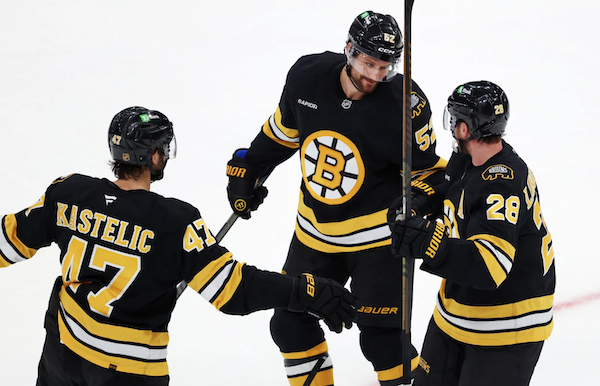
The season is still young, but the early results for this trio have been promising. In just over 25 minutes together, Boston’s new fourth line is out-attempting opponents 30-21, outshooting them 17-6, and out-chancing them 13-8.
The most important thing any NHL fourth line can do is tilt the ice in their team’s favor. That involves suppressing chances in your zone and generating a heavy forecheck that maintains possession. This season, the Kuraly, Kastelic, and Khusnutdinov line has done just that, especially regarding shot attempt metrics.
According to Moneypuck, among all forward lines that have skated 25 minutes together, Boston’s fourth line ranks twelfth in shot attempt percentage (58.8 percent), fifth in expected goals percentage (70 percent), and third in unblocked shot attempt percentage (66.7 percent).
This means that when the Kuraly, Kastelic, and Khusnutdinov are on the ice together, the puck is 200 feet from Boston’s net, and the trio maintains possession, generates chances, and creates momentum in the offensive zone.
It may not be the biggest x-factor for the Black and Gold, but it’s unquestionably clear that this team has excelled when its fourth line is on the ice. Deploying a fourth line that can tilt the ice and swing momentum is a weapon in today’s NHL, and it looks like the Boston Bruins may finally have one this season.



Leave a Reply