By: Tom Calautti | @TCalauttis
It’s never too early to talk trades, and with the NHL Olympic roster freeze exactly three weeks away, there’s no time like the present to discuss rumors and rumblings.
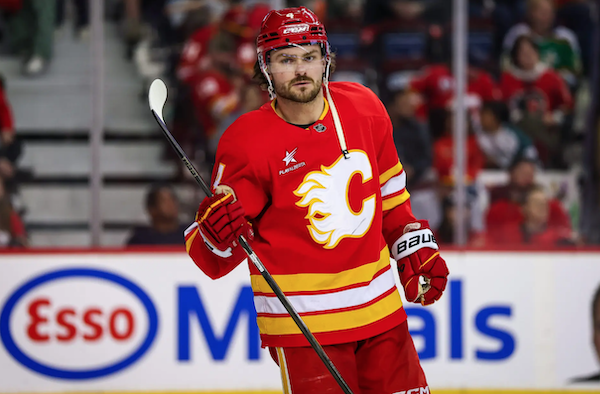
The latest bombshell report came from Jimmy Murphy of RG Media regarding Calgary Flames defenseman Rasmus Andersson. According to Murphy’s reporting, the Boston Bruins have already made an offer for the soon-to-be Olympian, which includes their own 2025 first-round pick and defenseman Mason Lohrei.
An Andersson trade would qualify as Don Sweeney’s first ‘big swing’ since last season’s trade deadline teardown. The question he (and Bruins fans) has to consider: Is the deal worth it?
For those unfamiliar with him, Andersson is a 29-year-old (turning 30 in October) right-shot defenseman who measures in at 6’1”, 202lbs. The veteran defenseman has spent eight seasons in the NHL, posting 57-203-260 over the course of 582 career games (all with Calgary).
Anderson would undoubtedly provide an upgrade to the right side of Boston’s blueline, which Charlie-McAvoy, Henri Jokiharju, and Andrew Peeke are currently manning. What we need to determine is whether or not the Bruins should be willing to pay Calgary’s price to acquire
Argument for Andersson
When you look at Andersson’s numbers across his career, they’re solid for a two-way puck-moving defenseman who can make an impact on both ends of the ice. This season, he’s posted 10-19-29 through 46 games.
Andersson ranks 17th in the NHL in time on ice per game (24:09) for a Flames team that’s third-worst in the NHL in points. Despite how bad Calgary has been this season (and how many minutes he’s logged), their top defenseman has an even plus-minus at even strength.
Even though he’s playing for a team that’s destined for the lottery this season (and hasn’t qualified for the playoffs since 2021-22), his advanced metrics reinforce just how solid a defenseman he is.
Andersson became a full-time NHLer in 2018-19 and has played the large majority of every season since (has played in 70 or more games in six of the last seven seasons). Over that time, his stats are:
- Corsi: 51 percent
- Shots for: 51.1 percent
- Goals for: 50.6 percent
- Expected Goals: 50.6 percent
- Scoring Chances: 50.4 percent
- High-Danger Chances: 50.4 percent
For those who don’t like analytics, I’ll make things simple. Despite playing on a team that has missed the playoffs in five of the last eight seasons, Andersson has continuously proven that he can win his minutes, tilt the ice in his team’s favor, and provide an impact on both ends of the ice, no matter the talent around him.
If the Boston Bruins were to acquire Andersson, he would immediately slot into their top four and fix perhaps the most glaring issue on the roster this season.
The Bruins will roll out any combination of Charlie McAvoy, Nikita Zadorov, Hampus Lindholm (when he returns from injury), and Andersson as they please. This would allow them to lessen Zadorov’s defensive responsibilities, provide a more stable and reliable partner for Lindholm, and give them one of the best blue lines in the league.
There’s a legitimate argument to be made that Boston should swing for Andersson, but there are also plenty of reasons why he just might not fit.
Avoid Andersson
The argument against the Bruins acquiring Andersson comes down to three different factors: timeline, cost, and asset management.
The first and easiest argument is that trading for a defenseman turning 30 years old and in need of an extension is something ‘win now’ teams do. As fun as the Bruins have been over this last stretch, they’ve proven that they’re still looking towards the future.
Is it in the team’s best long-term interest to acquire yet another player approaching 30 in need of a significant salary increase (making $4.55 million per year on deal that expires at the end of this season) when the priority should be developing young talent? Let’s assume the trade comes with an extension (it better, otherwise don’t make the deal), by the time the Bruins are truly contenders again, do we think Andersson’s play will justify his paycheck? That’s issue number one.
Issue number two is the cost of acquiring him. Boston has four first-round picks over the next two seasons. This year, they have their own selection and a top-five protected pick from the Toronto Maple Leafs. Given how tight the East has been and the talent level of both teams, it isn’t unreasonable that both groups could end up outside the playoff structure.
The Bruins’ prospect pool, although vastly improved, is still in need of a much-needed talent injection. Is it worth trading a chance at a potential top-ten pick for the rest of Andersson’s prime? If Boston’s re-tool goes according to plan, they shouldn’t have many more opportunities this high in the draft. Is a number three or four defenseman due a raise worth that?
The last thing I talked about at the beginning of this section is asset management. I want to start by saying I think Mason Lohrei has made significant strides this season and is beginning to come into his own. That being said, he’s still someone I’m willing to move for a player of Andersson’s caliber.
Where I balk is the addition of the first-rounder, especially if it’s Boston’s first-rounder as reported in the article. The Bruins don’t have a surplus of assets they’re willing to move on from. James Hagens is untouchable, Will Zellers is a rising star, and the organization is high on Frederic Brunet and Dans Locmelis.
Outside of those four, you’re looking at the likes of Lohrei, Matt Poitras, and maybe Fabian Lysell as potential non-NHL skaters that really move the needle for opposing GMs. This caliber of trade feels like it’ll involve a first-round pick and more. Do the Boston Bruins really want to sacrifice the capital they just acquired in a move for Andersson?
Look, there are solid arguments to be made in both directions, and after last season’s trade deadline, it’s nice to hear that the Bruins are in on a big name instead of trading one.
Whatever Don Sweeney and Co. decide will be based on how they view the progression of the organization, the strength of the following two draft classes, and the team’s potential in the future.
No matter what happens, we’re in for an exciting trade season



Leave a Reply