By: Tom Calautti | Follow me on Twitter/X @TCalauttis
The Boston Bruins have a bad penalty kill, and it only seems to be getting worse. The Black and Gold currently sit 27th in the league in penalty kill percentage, and that number looks a heck of a lot uglier after Sunday night’s Stadium Series loss.
Things were going well for Boston as they jumped out to a 5-1 lead over the Tampa Bay Lightning and looked to be in complete control of the game with 11:42 remaining in the second period. The Bruins then took FIVE penalties in under five minutes, surrendering three power-play goals in the process.
I feel the need to state the obvious before we go any further: the Boston Bruins need to stay out of the penalty box. Their undisciplined play has cost them multiple points this season.
The officiating in the Stadium Series game was an issue, and some glaring non-calls against the Bolts helped them pull off a second-period comeback. But make no mistake, the Bruins were complicit in their own demise.
The rate at which Boston takes penalties is a substantial issue for this team. That said, their inability to negate those penalties and secure timely kills is equally essential.
The Bruins’ penalty kill has been lackluster all season, but lately, opponents seem almost guaranteed to score at least one power-play goal per game. I rewatched every man-advantage goal allowed over the past two months and think I might’ve found an issue that’s ailing the penalty kill: the Bruins are too passive defending forwards in the bottom half of their zone.
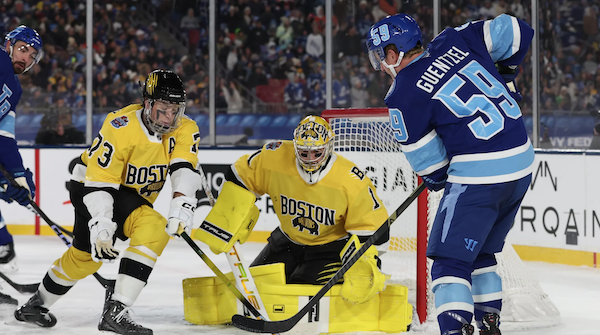
My attention was first grabbed during the Stadium Series when Oliver Bjorkstrand knocked home a loose puck in front of Jeremy Swayman to cut the lead to 5-2. During that sequence (shown below), primary distributor Jake Guentzel gathered the puck at the bottom of the circle (17-second mark of the clip).
For the best NHL odds to win the Stanley Cup, there’s no better company than the FanDuel Sportsbook for your online sports gambling needs. FanDuel offers competitive odds and futures on sports worldwide and is well-trusted for its secure sites across all devices. New customers who sign up for a new account and first-time deposit will be eligible for incredible sign-up bonuses, so take advantage and get on board today, as the 2025-26 NHL regular season is officially underway. Please gamble responsibly.
You’ll notice that Boston’s defenders opt to sag off of Guentzel and retreat towards their net, allowing him time and space to improve his shooting angle and open up new passing lines. I thought it was an odd decision to give Guentzel that much space, given where he was on the ice. After reviewing more tape, it looks like Boston has fallen prey to this issue MANY times this season.
Go back to last Saturday’s thrilling 4-3 victory over the Montreal Canadiens. Two of Montreal’s three goals came on the man-advantage off the stick of Cole Caufield. Guess where he was positioned? At the bottom of the zone between the goal line and the dot, same as Gunetzel.
The first of his goals comes off a wicked one-timer from the bottom of the right circle. You’ll notice in the video below that while Caufield and teammate Nick Suzuki exchange passes, no Bruin ever attempts to challenge Caufield when he has possession, giving him ample time and space to tee up his shot.
That lack of aggressiveness has gotten the better of the Bruins plenty this season, and it bit them again in the Montreal game. Caufield’s second goal is a bit more of a ‘tip your hat’ situation, where the player scores from an incredible angle. That being said, it’s yet another instance where Boston doesn’t pressure the low forward when he gains possession and basically waits for him to make a move instead of applying any pressure.
A similar situation occurred at the end of the Siblings Trip when the Bruins got thumped in Dallas, 6-2 by the Stars. Boston allowed Wyatt Johnston to score on a one-timer from that bottom of the circle spot, then allowed rookie Mavrik Bourque to do the same.
You’ll see in the Bourque goal above that the Bruins get caught out of position, which forces Mark Kastelic to abandon Bourque and leave him wide open in the penalty kill’s weak point (that bottom of the circle area). Bourque is given time, space, and two chances at beating Jeremy Swayman to provide Dallas with an early two-goal lead.
This isn’t a new issue for Boston, and you can trace it all the way back to the team’s December 11th victory over the Winnipeg Jets. In that contest, the Bruins surrendered yet another power-play goal from the bottom of the circle.
The Jets filter the puck down to Cole Perfetti, who has the time to survey the ice, decide a passing lane isn’t there, take the puck to the net, and get a stuff attempt on Swayman. Since Boston’s defenders were stationary, Gabe Vilardi is able to sneak into the top of the crease and slap home a rebound.
Boston’s penchant for passivity when it comes to low-zone puck possession also makes them more susceptible to back-door and net-front plays from opponents. A perfect example of that came on December 18th in a loss to the Edmonton Oilers.
Connor McDavid gets the puck below the goal line, and the Bruins decide not to pressure him. The three lowest Boston defenders get caught puck-watching as McDavid wheels the puck across the goal line, and Sean Kuraly is late picking up Ryan Nugent-Hopkins’ net drive.
Since December 2nd, the Bruins have given up power-play goals from that area of the ice against Tampa, Dallas, Montreal, New York (Rangers), Utah, and Seattle. No two plays are exactly alike, but almost every goal I mentioned involves an opposing forward positioned at the bottom of the circle either possessing the puck unchallenged and looking for passing lanes or skating unimpeded to high-danger areas without any resistance from the Bruins.
There are plenty of issues to consider when addressing this. Staying out of the box would probably be the most efficient solution. Boston could try to upgrade its defensive personnel at the trade deadline. Maybe the Bruins do some self-scouting over the Olympic break and decide they need to rethink their strategy when on the kill.
Whatever they decide, it’s become evident that opposing teams have found a glitch in Boston’s penalty killing structure. It’s a tough ask to change course this late in the season, but if the Bruins want to improve their kill, they need to be more aggressive on the penalty kill.



Leave a Reply