By: Ellie Man | Follow me on Twitter/X @ellieyym
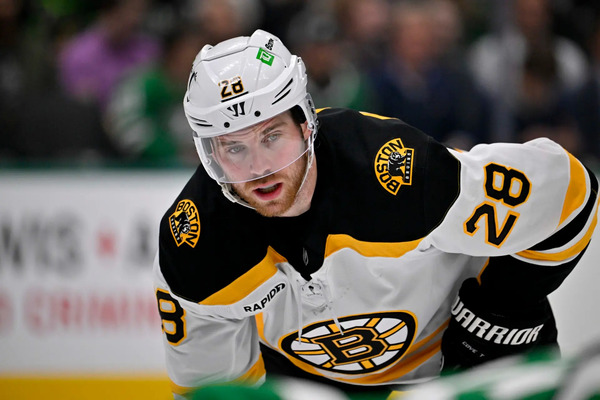
Elias Lindholm has unfortunately and undeniably struggled with the Bruins. When Don Sweeney signed him as a free agent in 2024, the general manager thought he had found a competitive player to anchor the team’s top line. Sadly, this plan hasn’t quite worked out.
Sharing a line with David Pastrňák and Morgan Geekie, the Swede struggled to establish himself and could not drive forward attack as the Bruins were hoping for. Last season, he tallied 48 points (17G, 31A), while his linemates saw greater success with 100 points (29G, 71A) and 68 points (39G, 29A), respectively. Lindholm achieved one more point than the season before, when he first joined the Bruins, though he played 13 fewer games. This effort includes 3 game-winning goals, but this offensive production remains underwhelming for a player in a lead role. The solution to this problem? Move Lindholm from the first line.
Much concern over Lindholm and his form revolves around his contract, signed at a $7.75 million AAV for 7 years. But with the salary cap increasing and player earnings continuing to rise, his price tag isn’t the worst of its kind. His cap hit ranks 36th among centers in the National Hockey League, placing him closer to the market for a second-line center than a first-line forward. Therefore, Bruins fans should temper their expectations and reduce the pressure on the Swede to justify every dollar of his contract.
Standing at 6’1” and 200 pounds, Lindholm is solid on defense as a two-way forward. However, he plays at a slower pace and lacks the creativity required for the top line. He is also weaker on the offensive front, not being as flashy of a scorer or playmaker. As such, shifting Lindholm to another line could open opportunities for younger and more dynamic players, such as new addition JJ Peterka.
With the new season coming up soon and a subsequent shakeup in the roster pending, Lindholm’s place will have to be reevaluated to find a role that better aligns with his strengths. He’s proven reliable on the faceoffs and defensively responsible, in a similar vein to Mark Kastelic. This suggests that Lindholm would fit well in the bottom-six, providing a steady veteran presence. That being said, Kastelic, Sean Kuraly, and Tanner Jeannot proved a formidable fourth liner last season, all putting up 22 points each. Consequently, I’d be hesitant to break up that established trio.
Furthermore, reduced time on ice might actually benefit the 31-year-old forward. Two seasons ago, the center suffered an injury, and the ongoing impact has been a point of worry. Lindholm indicated that lingering back problems continued to plague him throughout the season and negatively impacted his performance. Having played 69 games last season, averaged 18:26 minutes on ice, and represented Sweden in the Milano Cortina Winter Olympics, Lindholm has maintained a heavy workload. Therefore, a less demanding role could support his performance and his longevity by lessening the strain on his body.
Lindholm’s career high was five years ago in the 2021-22 season, which saw him play all 82 games in the regular season and average a point per game (42G, 40A). It’s unknown whether the center will return to this form, with age catching up and the wear of a long career presenting further risk of offensive decline. But to optimize the Bruins’ lineup and advance further beyond the first round of the Stanley Cup Playoffs, the team will have to take a look at what other lines the Swede can best fit.


Leave a Reply