By: Camryn Meece | Follow me on Twitter / X @MeeceCamryn
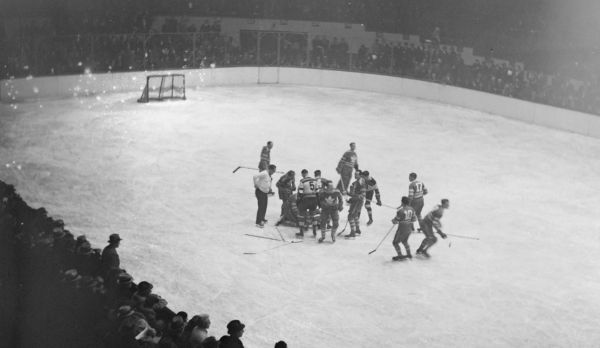
On December 12, 1933, the Boston Bruins and Toronto Maple Leafs met at Boston Garden for their second matchup of the season. By the end of the night, Toronto forward Ace Bailey would be carried off the ice with a serious head injury that ended his playing career.
The incident happened in the second period while the Maple Leafs were shorthanded and protecting a lead. Bailey was helping kill the Bruins’ penalty when Boston defenseman Eddie Shore rushed up the ice. Accounts differ on what happened next. One historical account says Toronto’s King Clancy knocked Shore down with a check, while another says Red Horner tripped him into the boards. Both accounts agree that Shore got back to his feet and went after a Toronto player, apparently mistaking Bailey for the man who had brought him down.
Bailey had moved into a defensive position in front of Shore. With his back turned to the Bruins defenseman, Bailey never saw him coming. Shore collided with Bailey, sending him crashing backward onto the ice. Bailey hit his head on the ice and stayed down as players from both teams rushed to his side.
Shore didn’t seem to realize how badly Bailey was hurt, which angered Toronto’s Red Horner. Horner punched Shore, knocking him to the ice and leaving him unconscious for several minutes. As players from both teams gathered around, attention soon returned to Bailey, who was taken off the ice and rushed to the hospital.
Bailey’s injury was more serious than initially thought. He had suffered a fractured skull and was in critical condition following the collision. At 30, Bailey had spent nearly eight seasons with the Toronto Maple Leafs and had become one of the team’s leading forwards. During the 1928-29 season, he led the National Hockey League (NHL) in both goals and points. Although he survived the injury, he never returned to professional hockey.
The incident had consequences for both Shore and Horner. NHL managing director Frank Patrick suspended Shore for 16 games, while Horner received a six-game suspension for his role in the fight. Shore returned to the Bruins lineup in January 1934. Around the same time, Ottawa Journal sports editor Walter Gilhooly proposed a benefit game to raise money for Bailey and his family. At a meeting of NHL governors on January 24, Montreal Maroons owner James Strachan also suggested an all-star game, and the league approved it.
The benefit game took place on February 14, 1934, at Maple Leaf Gardens in Toronto. The Maple Leafs faced an all-star team made up of players from the rest of the league. More than 14,000 fans attended, and the game raised $20,909.40 for Bailey and his family. Before the game, Bailey and Shore met and shook hands. The Maple Leafs also retired Bailey’s No. 6, marking the first time a professional sports team had retired a player’s number. The NHL introduced its official All-Star Game in 1947, 13 years after the benefit.


Leave a Reply