By: Ryan Jainchill | Follow me on Twitter / X @Jainchill_Ryan
Off to a 3-1-0 start to the 2025-26 NHL season, the Boston Bruins have shown significant strides from last season’s bottoming out. Whether it’s contributions from up and down the lineup, a defensive structure that has limited shots against, or a goaltending tandem returning to form, the Bruins have impressed many in the first week of play. The most significant change from last season to this season may be the special teams play, particularly the penalty kill.
While the sample size is minimal, the Bruins have gone 14/14 on the penalty kill to start the season, which is tied for the league lead. For a team known for mixing it up in the corners and in front of the net, having a strong penalty kill to compensate is key to Boston’s success. Again, while it is still early in the season and the Bruins’ opponents are a combined 6/45 on the power play this season, the signs of a strong unit that can neutralize a team’s top unit are there.
In the season opener, the Bruins killed off five penalties against a typically lethal Washington Capitals power play, including killing a five-on-three in the early second period. In the victory over the Chicago Blackhawks, the Bruins killed off three penalties, which became crucial in sending the game to overtime. In the 3-1 win over the Buffalo Sabres, they went a perfect 4/4, which kept the Sabres from gaining momentum, and in the loss to the Tampa Bay Lightning on Monday, a penalty kill late in the game kept it a one-goal game, giving the Bruins a potential chance to tie the game.
The change in results is drastic from last season. The Bruins finished with a 76.3% penalty kill last year, which ranked 24th in the league. They ranked fourth in the league in power play goals against with 57 and were tied for third with the Nashville Predators for averaging 9.8 penalty minutes a game. A combination of an undisciplined team that struggled to keep the puck out of their own net when a man down hampered the Bruins in 2024-25 and contributed to their bottoming out.
Three skaters are averaging over three minutes of penalty kill time a night: Nikita Zadorov (3:33), Andrew Peeke (3:26) and Sean Kuraly (3:00). Zadorov, who leads the team in hits with 23, has only two penalty minutes this season, a stark contrast from his league-leading 145 last year. For Zadorov, his best ability is availability. When he stays out of the penalty box and can kill, the Bruins have had success. For Peeke, his 13 blocked shots lead the team and rank third in the league, which has been crucial for the team’s success this season.
The adage is that your goalie can be your best penalty killer, which has been true for the Bruins thus far. Jeremy Swayman and Joonas Korpisalo have combined for a .914 save percentage this season and have allowed nine combined goals. Swayman, who had a rough 2024-25 campaign, has been stellar to start the season, posting a 2-0-0 record with a 1.00 goals against average and a save percentage of .966. Korpisalo, who suffered the Bruins’ only loss of the season so far, is 1-1-0 with a 3.50 GAA and a .851 save percentage, but made many game-altering saves in the Bruins’ victory over Chicago.
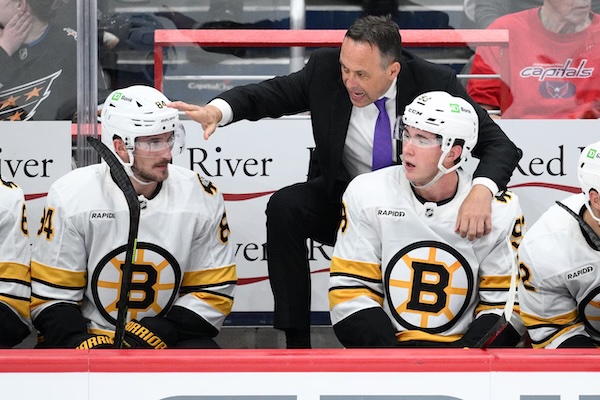
While it’s not official who is managing the penalty kill, credit has to be given to all four coaches behind the Bruins’ bench. Assistant Coach Steve Spott, who was hired in the offseason to work on the power play, can be credited with a lot of the special teams work. Still, the likes of Assistant Coaches Chris Kelly and Jay Leach, who have defensive experience, have also been key in the Bruins’ maintaining a strong kill. For first time Head Coach Marco Sturm, his assistants have helped shape the team in Sturm’s style of play, one that favors a strong defensive structure and welcomes creativity with the puck.
Is a perfect penalty kill sustainable? Of course not. But are the signs there for a strong kill that can limit shots against? Yes. The efforts of the forwards and defencemen to limit quality opportunities and disrupt passing lanes have allowed their goalies to see shots clearly, which is crucial for a successful penalty kill. Again, while it is early in the season and the sample size is small, this early-season trend can pay dividends as the season goes along.


Leave a Reply