By: Gregory Thibeau | Follow me on Twitter / X @OriginalTebow
The Providence Bruins closed out the regular season with a 4-2 loss to Utica on Saturday night at Amica Mutual Pavilion, their second straight loss to the Comets and a rare stumble for a team that spent most of the year at the top of the American Hockey League. It’s not unfamiliar territory. Earlier this season, Providence responded to back-to-back losses with winning streaks of eight in February and five in March.
This time feels different, not because anything changes, but because of what it reinforces heading into the Calder Cup Playoffs.
Providence finishes at 54-16-2-0, the best record in the league and winner of the MacGregor Kilpatrick Trophy. That body of work stands on its own, but the final weekend sharpened the focus on details that carry more weight in playoff hockey.
Before puck drop, the Bruins recognized the core of that success. Michael DiPietro, who led the league in wins, goals-against average, and save percentage, was named team MVP. Georgii Merkulov finished as the leading scorer, Frederic Brunet earned top defenseman honors, Riley Tufte was named both Three Stars Award winner and Fan Favorite, and Patrick Brown’s plus-minus recognition underscored the structure that has defined this group all season: disciplined, connected, and difficult to play against.
That identity showed early. Providence controlled the pace in the first period and carried a 1-0 lead into the break, but the game shifted in the second period the same way it did the night before in Utica. The Bruins lost their rhythm, penalties came at the wrong time, and momentum flipped quickly.
Over the final two games of the regular season, Providence went 0-for-8 on the power play while allowing three goals against on the penalty kill, a combination that ultimately decided both games. It’s not representative of their season, but it is exactly how playoff games turn.
Head coach Ryan Mougenel didn’t overcomplicate it afterward. “We weren’t playing how we needed to play to win,” he said. “We weren’t valuing the things that we value.”
That showed up in the details. Breakouts weren’t as clean, offensive zone time was harder to sustain, and when momentum slipped, it didn’t come back quickly. Special teams, a strength over the course of the year, became a weakness at the wrong time.
That ties into a trend that’s been there beneath the surface. Providence’s power play finished top ten overall but ranks 28th at home (15.0%) compared to first in the league on the road (26.5%). The penalty kill shows a similar split, stronger away (5th, 85.0%) than at home (12th, 83.5%). For a team set up with home ice advantage, that’s something to watch.
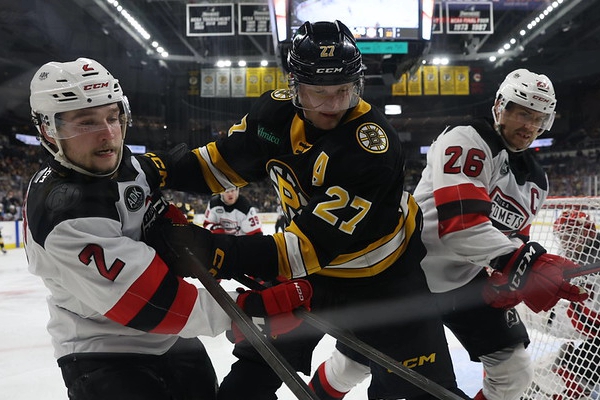
Utica played with the urgency of a team fighting for its season. They brought physicality, edge, and consistent pressure across both games, with scrums after whistles, battles along the boards, and traffic near the crease. It didn’t feel like a typical regular-season series. It felt like a playoff game. And it might lead to one.
The Comets did what they needed to do, winning both games while Rochester dropped four straight to open the door. Utica has pulled even, but Rochester still controls its fate with one game left against Hershey. One point eliminates Utica. A regulation loss puts them in. If the matchup materializes, the tone has already been established.
None of this changes what Providence brings into the playoffs. They have home ice, a first-round bye, and the best goaltender in the league. DiPietro has been the backbone all season, making timely saves and controlling rebounds under pressure. Brown, Brunet, Tufte, and the rest of the group have consistently executed Mougenel’s structure in front of him. That identity carried them to the top of the standings. If it holds, 14 wins gets them the Calder Cup.
The final weekend didn’t damage that identity. It clarified it. Special teams need to reset, discipline must tighten, and the structure has to hold for a full sixty minutes. In the playoffs, swings don’t just cost momentum; they cost games.
After the final horn, the mood reflected that balance. There was frustration in the result, but the crowd stayed. Players handed out game-worn jerseys, signed hats and shirts, and posed on the ice for a photo with the Macgregor Kilpatrick Trophy as fans acknowledged what this season has been.
They also understand what’s still missing. Providence hasn’t reached the Calder Cup Final since 1999, and strong regular seasons haven’t led to playoff results. That’s the expectation now. The regular season is a footnote. For this group, it comes down to one number: 14 wins.


Leave a Reply