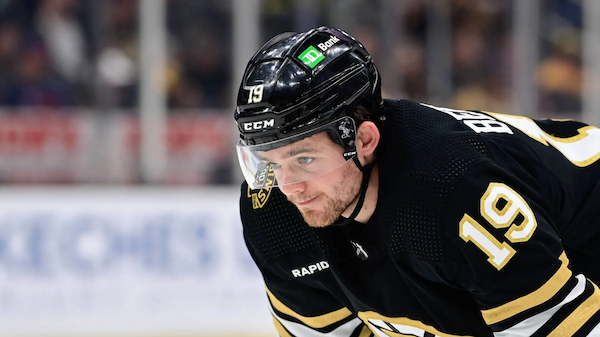
By: Declan Flavin | Follow me on Twitter / X @FlavinDeclan
The 2024–25 Boston Bruins lacked top-end talent, but they also struggled with consistency from their bottom lines. A John Beecher–Mark Kastelic–Cole Koepke fourth-line combination fared well early in the season but quickly lost footing due to health and eventual inefficiency.
The inconsistent efficiency of these depth lines can be attributed in large part to what Bruins general manager Don Sweeney seems to recognize as a lack of energy. Although the acquisitions should hopefully address this, there is more than a possibility for in-house options to improve. Among others, Beecher is too young and fundamentally capable to not be part of the solution going forward.
When looking at 24-year-old Beecher’s upside, it is hard not to recognize the defensive game he prides himself on. When he’s at his best, he has a knack for being in the right defensive spots to either disrupt a passing lane or block a shot. However, Beecher’s hits per game dropping a full point—from 2.2 to 1.1—could help clarify what felt like a subpar sophomore year. Although he was doing things away from the puck, he could be doing more in terms of what he brings around the puck.
If Beecher can pester incoming opponents in addition to what he has already brought, he will likely retain his spot in the lineup. After all, Sweeney did say that the acquisitions and roster are “guys that are going to show up when the whistle blows, and drag people in with them, and if they aren’t dragged in then they won’t play.”
As for the nuances of his responsible style as a player, Beecher won 52 percent of his faceoffs this past season and averaged 1:31 of penalty kill time per game. For a team that could use more faceoff victories and a reinvigorated penalty kill, he produces value in those areas. A drop-off in faceoff win percentage can go unrecognized, but it continues to play a big role in how teams can dictate the puck possession of the game.
The Bruins’ consistency on the penalty kill was nowhere near where it usually is, and while Beecher was along for that, he’s certainly been trusted with penalty kill reps for a reason. The next step for him will be working hard at picking the right spots to converge against the opposing power play.
What also helps Beecher is that he has the skating and size to complement a mostly north-style approach. A fleet-of-foot skater with a 6-foot-3, 216-pound frame is always a plus in the modern NHL, where prototypes like that are becoming more of the norm for contending teams.
He usually does not get too complicated with his offensive attack, but as with his defensive game, increased energy can benefit both him and the team. With his frame, Beecher can be pressuring defensemen into the boards and winning a lot of puck battles. There were instances last season where black and gold sweaters would go east–west with their offensive approach, but for Beecher, he simply needs to maintain good energy consistently.
Assuming Beecher’s ability as a centerman is to be maximized, he will have competition—unless the Bruins want to try pairing him as a left wing with Kastelic again. Fraser Minten and Matthew Poitras, along with Kastelic and Sean Kuraly, emerge as the centers Beecher will be competing with through camp. Going through it a little bit now, the fit in the lineup at the center position does not seem too likely.
Obviously, there will probably be a lot of rotation around the bottom-six forwards, but Beecher needs to focus on his game more than where he fits in the lineup specifically. At the end of the day, Beecher is competing as a natural centerman against youth, a somewhat recently concussed Kastelic, and a veteran in Kuraly. As long as he imposes his physicality to add to his intangibles, Bruins head coach Marco Sturm will find a way to have him in the lineup.



Leave a Reply