By: Ryan Jainchill | Follow me on Twitter / X @Jainchill_Ryan
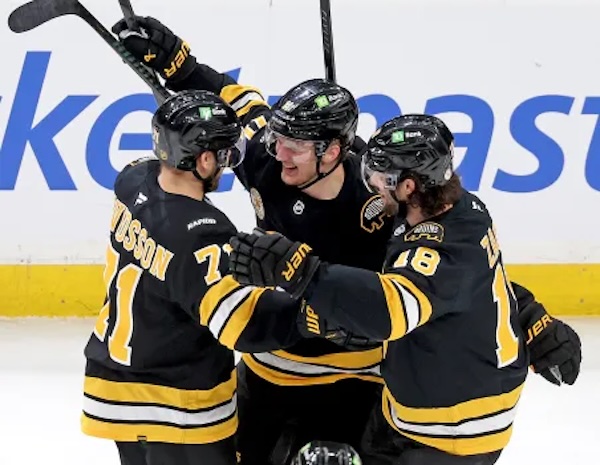
The Boston Bruins entered the regular season with questions about scoring from their forward group outside of their top line. But right away, the trio of Pavel Zacha, Casey Mittelstadt and Viktor Arvidsson proved that they were a formidable second line and contributed greatly to the 100-point Bruins. Heading into next season, management needs to ensure the second line is reunited.
As a line, Zacha, Mittelstadt and Arvidsson combined for 66-91-157 and were a plus 36. The trio played together for 59 games, recording 585 lines and outscoring opponents 41-22. The 41 combined goals when they were on the ice were third best in the league for forward lines with a minimum of 500 minutes together. The trio only trailed the Colorado Avalanche’s top line of Nathan MacKinnon, Artturi Lehkonen and Martin Necas and the Winnipeg Jets’ top line of Mark Scheifele, Kyle Connor and Gabe Vilardi.
It was a career year for Zacha in his age-28 season. He scored 30 goals, his first time reaching that plateau in his career. His 35 assists were third-best on the team and the third-highest of his career, the two prior of which came in his first two seasons in Boston. Zacha also had a career-high 11 power-play goals, only trailing Morgan Geekie’s 12 for the team lead.
Mittelstadt, who was acquired from Colorado in the Charlie Coyle trade at the 2025 NHL Trade Deadline, posted 15-27-42, the third highest of his career. The 27-year-old was a career-high plus 12 and had 13 five-on-five goals, the second most of his nine-year career. After playing primarily down the middle in the 18 games after the trade last season, Mittelstadt was a mainstay to the left of Zacha, providing another faceoff option if needed.
Last offseason, the Bruins took a flier on Arvidsson in a trade with the Edmonton Oilers for the final year of his contract. That gamble paid off for both sides, as the Swedish winger posted 25-29-54 in 69 games and finished fifth on the team in scoring. Arvidsson’s 54 points were the fourth highest of his career, coming close to the numbers he had as a young scorer with the Nashville Predators.
The trio thrived all season, especially during the calendar year of 2026. In those 41 games, that line combined for 102 points, with Arvidsson just under a point per game in the second half and Zacha over due to him missing a handful of games. Come the playoffs, the line was not as effective, combining for 3-4-7 in six games and contributing as a unit only in game two. However, Arvidsson suffered an injury in game four and missed the final two games of the series.
In order for this line to reunite next season, which it should, decisions need to be made about all three forwards. The simplest one is Arvidsson, who is an unrestricted free agent. Reports had surfaced around the trade deadline that a deal was nearing, but nothing has come of it since. Arvidsson’s resurgence makes him a hot commodity on the open market, but with cap space to spend and the natural fit of the 33-year-old in the middle six, General Manager Don Sweeney should look to bring back the speedy scorer.
Mittelstadt, who has one year left on a contract that pays him $5.75 million with a nine-team no-trade list according to PuckPedia, is expendable, but it looks like it would only be for a true upgrade in the top-six or a top-four defenseman. With the money somewhat of a hindrance, it is hard to see Mittelstadt moving unless the Bruins went big-game hunting and used him to make the salary work.
For Zacha, his value is at an all-time high and if Sweeney were to move him, the Bruins would get a haul back. With one year left at $4.75 million, Zacha, like Mittelstadt, is a prime extension candidate for the offseason. Given his career year, ability to play special teams and his versatility, Zacha is incredibly valuable to the Bruins and moving him, even if his value is high, would be a mistake. Even if Arvidsson walks and/or Mittelstadt is dealt, keeping Zacha allows the Bruins to have a versatile center who has thrived alongside and away from David Pastrnak.
With needs in the top-six, primarily on the top line, having a strong second line can really help the Bruins next season, especially with prospects and young forwards starting to emerge and become options. The only reasons that this line should not be together once again next season would be either Arvidsson’s contract demands, a move for a top line center or winger that requires one of Mittelstadt or Zacha to be moved, or Head Coach Marco Sturm trusts a youngster like Fraser Minten, Marat Khusnutdinov, or James Hagens to step into one of the aforementioned trio’s shoes.
Given how much heavy lifting the second line did last season for a Bruins team with minimal expectations, ensuring that, by the metrics, the third-best offensive line in hockey last season is back for next season. While holes need to be filled, addressing the second line is not one of them and for a Bruins team that needs more scoring, keeping that line together is crucial.


Leave a Reply