By: Camryn Meece | Follow me on Twitter / X @MeeceCamryn
The Boston Bruins were putting up a fight on May 24, 1988, facing the defending Stanley Cup champion Edmonton Oilers in Game 4 of the Stanley Cup Final. Boston trailed 3-0 in the series and needed a win to keep its championship hopes alive. Then, the lights went out.
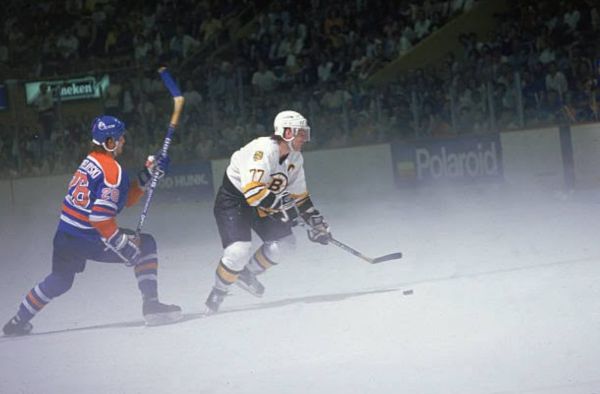
It was already an unusual night at the Boston Garden. Temperatures inside the nearly 60-year-old arena had climbed above 80 degrees Fahrenheit, and with no air conditioning, fog began to form over the ice. The fog became so bad that play had to be stopped several times while players skated around the ice to clear it. Despite the conditions, the Bruins delivered perhaps their best performance of the series.
Edmonton opened the scoring race just 10 seconds into the first period when Glenn Anderson found the net on the Oilers’ first shot. Esa Tikkanen, the Oilers’ left wing, then extended the lead to 2-0 on a five-on-three power play, putting Boston in an early hole. The Bruins responded late in the first period. Greg Hawgood, a 19-year-old defenseman making his first appearance of the series, cut Edmonton’s led to 2-1. Then his defensive partner, another 19-year-old rookie named Glen Wesley, took over.
Early in the second period, Glen Wesley stole the puck from Wayne Gretzky during an Edmonton power play and scored shorthanded to tie the game. Just 85 seconds later, Wesley scored again, this time on a Boston power play, to give the Bruins a 3-2 lead. The Bruins had completely turned the game around.
Boston’s lead did not last long. With Edmonton on a power play, Steve Smith’s shot from the left point was deflected by Craig Simpson and found the net with 3:23 left in the second period. The goal tied the game at 3-3. Before the teams could even take the next faceoff, the lights went out at Boston Garden.
At approximately 9:33 p.m., a 4,000-volt switch on a transformer outside the Garden overloaded, knocking out the building’s main power. Only the emergency lights remained on. Staff worked to evacuate the crowd of 14,451 people, while sending the players back to their dressing rooms. By 10 p.m., the power had been restored, but most of the crowd had already left. There was also no guarantee that the power would remain stable if the game resumed. After meeting with officials from the Bruins and Oilers, National Hockey League (NHL) President John Ziegler decided the game could not continue.
The NHL’s bylaws provided an answer for such an unlikely situation. If a playoff game could not be completed because of circumstances beyond a team’s control, it would be replayed in its entirety at the end of the series if necessary. The teams would return to Edmonton two days later for a new Game 4.
“You don’t know really how to feel. For 37 minutes you play the most intense hockey of your life, and then they tell you to forget it.”
— Bruins goaltender Andy Moog
Two days later, the Bruins and Oilers met again at Northlands Coliseum. This time, Edmonton won 6-3, completing the sweep and winning its fourth Stanley Cup in five years.
The May 24, 1988, game was never completed, although its individual statistics remained official. Wesley’s two goals, Hawgood’s goal, and Simpson’s tying goal all remained in the record books. It was the first Stanley Cup Final game since 1927 to end without determining a winner.


Leave a Reply