By: Camryn Meece | Follow me on Twitter / X @MeeceCamryn
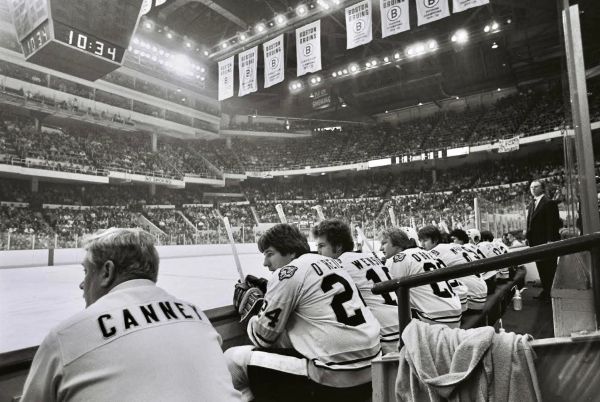
31 years ago today, on September 26, 1995, the Boston Bruins played their final game at the Boston Garden. The Bruins had called the Garden home since 1928, and over those 67 years, they created some of their most memorable moments there. The Bruins won Stanley Cups there, Bobby Orr scored one of the most famous goals in NHL history, and generations of players built their careers on the Garden’s ice. Before looking at how the Bruins said goodbye to the building in 1995, it is worth looking back at some of the moments that made the Garden such an important part of Bruins history.
On November 20, 1928, they played their first game in the building against the Montreal Canadiens. Almost 17,000 fans packed the Garden for the occasion, but the Bruins lost 1-0. Montreal’s Sylvio Mantha scored the only goal, while a late goal by Dit Clapper was waved off. That game began the Bruins’ 67-year run at the Garden. Just a few months later, Boston won its first Stanley Cup, defeating the New York Rangers in the 1929 Final. The Bruins won two more championships at the Garden in 1939 and 1941, with players such as Milt Schmidt, Bobby Bauer, and Woody Dumart becoming stars during that era.
The Bruins’ success did not continue uninterrupted. After the 1941 Stanley Cup, Boston went through a much more difficult stretch. The team missed the playoffs several times during the 1950s and early 1960s, and there were seasons when the Bruins were near the bottom of the National Hockey League’s (NHL) standings.
The struggles were especially noticeable in the early 1960s. The struggles were especially noticeable in the early 1960s. Boston finished last in the NHL for three consecutive seasons, from 1960-61 through 1962-63. During those difficult years, the Garden still remained an important part of Bruins fans’ lives. Maureen and Karen Connolly began attending games there in the 1960s, joking at first that they were only “seat fillers” when their father couldn’t find anyone to use his tickets. That changed when Bobby Orr arrived in Boston. The sisters became regulars, and Maureen later remembered that the same people sat around them at nearly every game. Around this time, the Bruins began to turn things around, starting with the arrival of a young defenseman who would change the direction of the franchise.
Bobby Orr joined the Bruins in 1966 and began a new era for the team. Orr made his NHL debut that year on October 19 at the Boston Garden against the Detroit Red Wings. He quickly became one of the league’s best defensemen, while Phil Esposito, Johnny Bucyk, and other Bruins stars helped turn Boston into a contender again.
The Bruins returned to the Stanley Cup Final in 1970 for the first time since 1958. Boston faced the St. Louis Blues, and the series came down to Game 4 at the Garden on May 10. With the game tied in overtime, Orr scored the winning goal to give the Bruins their first Stanley Cup in 29 years.
Orr’s goal quickly became one of the most recognizable moments in hockey history. He was tripped as he scored, and photographer Ray Lussier captured the famous image of Orr flying through the air. The Garden erupted as fans climbed over the boards to celebrate with the players. Ted Green, who had been injured before the season and was unable to play, was also on the ice for the celebration as the Bruins finally had their Stanley Cup.
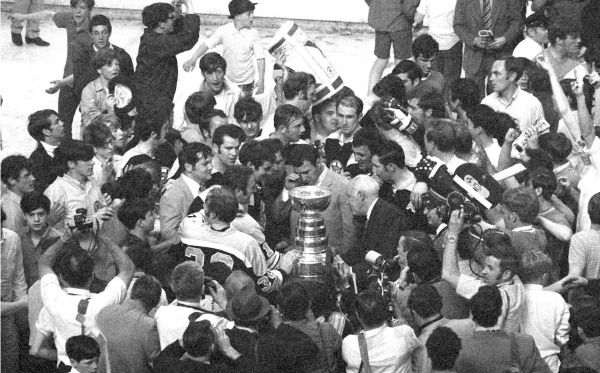
Two years later, the Bruins were back in the Stanley Cup Final. Boston defeated the New York Rangers in six games to win its second championship in three seasons. The Bruins had gone from struggling near the bottom of the NHL standings to winning two Stanley Cups in just three years.
In 1974, Bobby Orr scored an unusual goal against the Atlanta Flames while killing a penalty. Orr carried the puck into Atlanta’s zone, weaving around one Flames player after another as they tried to stop him. One player fell, then another, and eventually the goalie went down as Orr came around the net. With the net open, Orr put the puck in and sent the Garden crowd into a celebration.
The Garden could also intimidate visiting players. Blackhawks forward Stan Mikita once recalled a Bruins fan taking things a little too far, putting out a cigarette on his neck during a game. It was another example of just how close the fans were to the players in the old Garden.
Bobby Orr’s playing career in Boston had ended a few years earlier. Still, he returned to the Garden on January 9, 1979, when the Bruins retired his No. 4. Orr received a standing ovation that lasted several minutes as he made his way onto the ice. The Bruins then raised his number to the rafters at the Garden.
Boston Garden hosted another memorable jersey retirement on December 3, 1987, when the Bruins retired Phil Esposito’s No. 7. During the ceremony, Ray Bourque removed his No. 7 jersey to reveal a No. 77 underneath, then gave Esposito his old jersey.
“When Bourquey took the jersey off, I looked at him – and if you could read the lips, I said, ‘what the frick are you doing?’ He said, ‘this is yours, big fellow, and it always should’ve been yours.’ Well, I was stomped for words. It was a special moment for me and my family.” – Phil Esposito
Less than two years later, the Garden saw a much stranger moment. On January 28, 1989, 22-year-old Bruins fan Frank Barbaro Jr. jumped over the glass and onto the ice during a game against the Winnipeg Jets. Barbaro headed toward referee Bill McCreary after McCreary did not call a penalty on Winnipeg’s Paul Fenton, whose stick had bloodied Bruins defenseman Glen Wesley. Before Barbaro could reach the referee, linesman Ron Asselstine chased him down and sent him into the end boards. Barbaro was later taken into custody by Boston police and charged with trespassing and disorderly conduct.
Coming off the high from the “Big Bad Bruins” era, by the late 1980s, the Garden had another group of Bruins stars for fans to follow. Ray Bourque had become the team’s captain, while Cam Neely emerged as one of the league’s best goal scorers. The Bruins reached the Stanley Cup Final in 1988, their first appearance in the championship series since 1978. They also finally ended their long playoff drought against the Canadiens, beating Montreal in five games in the second round. The Bruins returned to the Final in 1990 but lost to Edmonton both times.
“That group of guys was a very special group. For me and my career, the group that I’ve been the closest to. Those relationships have lasted ever since.” – Ray Bourque
The Bruins entered the 1990s with Ray Bourque and Cam Neely leading another generation of players at the Boston Garden. The team was changing, and so was the building around them. After 67 years, the Bruins were getting closer to the end of their time at the Garden.
On September 26, 1995, the Bruins played their final game at the Boston Garden. Their opponent was the Montreal Canadiens, the same team they had faced in their first game at the building nearly 67 years earlier. The game was an exhibition, but it was played a little differently than a normal preseason game. Instead of three periods, the Bruins and Canadiens played two 25-minute halves to allow time for the ceremonies throughout the night.
Boston won the game 3-0, with Don Sweeney scoring the final goal in Boston Garden history. The game also brought some familiar faces back to the ice. Normand Leveille, whose playing career had been cut short by a brain aneurysm in 1983, returned to the Garden with help from Ray Bourque. Leveille skated around the ice with Bourque before leaving the ice for the final time.
After everyone else had left, Bobby Orr went back onto the ice for one final skate around the Boston Garden. He took a couple of laps by himself before leaving the ice. Orr later said he went back out to take “one last peek” and think about the old days, including the players, coaches, and trainers he had worked with during his career in Boston. With the building empty, Orr had one final moment on the ice before the Garden closed for good. The next day, demolition began.


Leave a Reply